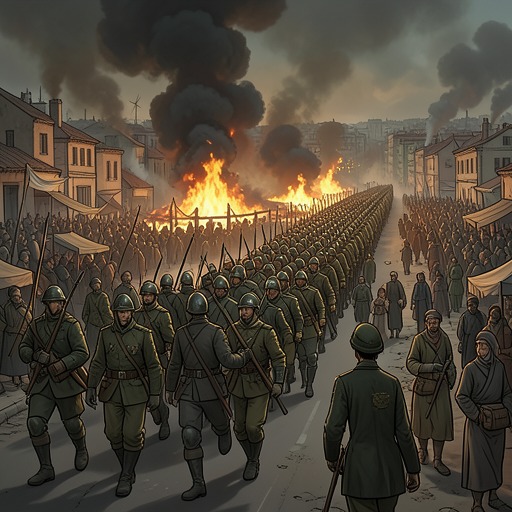
General Lang
World War ZGeneral Lang, commander of the Northern Front, is defined by a decision that turns military withdrawal into a moral catastrophe. During the collapse of Hamburg, he orders the remaining garrison to retreat north while leaving the refugees behind and forbids the soldiers from telling the civilians that they are being abandoned. His authority preserves a military force, but the order makes him responsible for the human beings sacrificed to that preservation; his subsequent suicide does not erase that responsibility and instead leaves his subordinate hating him more intensely for dying before judgment could reach him.
Command During the Collapse
General Lang appears at the point when ordinary communication and ordinary military geography have already failed. The Hamburg unit has been withdrawing since the first days of the Panic, but its earlier rally points were announced through civilian designations on an open channel so that refugees could find them. Lang’s new order is different: the troops must assemble at coded map-grid coordinates, using a map system that had not been used since the end of the Cold War. The destination is Schafstedt, just north of the Nord-Ostsee Kanal, effectively the northern edge of the retreating force’s territory.
The location is not the only shocking part of the order. Lang commands the unit to move toward Schleswig-Holstein without taking the civilians along and, more severely, without informing them that the army is leaving. The officer receiving the order asks for confirmation twice, suspecting a map error, a changed code, or another failure in the collapsing chain of command. Lang’s answer is unequivocal: the instructions are genuine, and the remnants of the Hamburg Garrison are to proceed north immediately.
The Order and Its Human Cost
The subordinate’s account presents Lang’s voice as shaking even over the gunfire. That detail gives the order a divided quality: Lang is not portrayed as calmly unaware of its consequences, but neither does his distress soften the command. The officer can accept the larger impossibility of the dead rising to consume the world; what he cannot accept is obeying an instruction that will indirectly cause mass murder.
Lang responds through the coercive logic of emergency command. He threatens prosecution for treason, warning that refusal will bring punishment with “Russian efficiency,” not only upon the officer but, more importantly, upon his men. The threat places the commander’s subordinate inside a deliberate trap. Obedience abandons the refugees; refusal exposes young, exhausted soldiers to prosecution or execution. Lang’s command therefore transforms conscience into a liability and makes the preservation of the unit depend upon accepting responsibility for those left outside its protection.
The withdrawal produces immediate rage among the civilians. As armored vehicles move away, people shout from buildings and accuse the soldiers of cowardice. The officer promises that the army will return the next day with more men, but the refugees do not believe him. One woman calls him a liar and cries that he is letting her baby die. Others try to follow the departing vehicles, while those trapped in buildings throw lamps, furniture, human waste, and gunfire at the retreating force. Lang’s decision is thus experienced from below not as a strategic abstraction but as a visible betrayal carried out by the soldiers who had been expected to defend them.
The System Behind the Decision
Lang’s order belongs to a wider wartime pattern in which survival is pursued by converting unprotected people into instruments of defense. The Redeker Plan makes that logic explicit: a small fraction of civilians are evacuated to a safe zone, while isolated, uninfected refugees are kept alive as “human bait” so that the undead remain fixed in place instead of pursuing the retreating army. Lang’s conduct in Hamburg is not identical to that plan, but it inhabits the same moral structure. Civilians become a delaying mass, and military survival is measured partly by how effectively the abandoned can hold the enemy’s attention.
The narrative also places Lang’s decision beside other forms of institutionalized violence. In Russia, soldiers are forced to vote on which comrades will be executed and then personally kill them with stones, binding the survivors through shared guilt. In the field, priests later claim the authority to kill infected soldiers themselves in the name of “Final Purification,” turning execution into religious duty. In the United States, public punishment and forced work gangs are defended as practical responses to a society that can no longer afford conventional prisons. These episodes differ in ideology and method, but together they show institutions suspending ordinary protections and distributing guilt through commands, procedures, and emergency necessities.
The Retreat and the Expendable Unit
Lang’s order is reinforced by the forces left behind to cover the withdrawal. On the way out of Hamburg, the garrison passes a Rapid Reaction Stabilization Unit that had already been badly mauled earlier in the week. The unit has been classified as expendable and is ordered to hold until the end, preventing too many zombies or refugees from following the retreating troops. Its sacrifice reveals that the abandonment of civilians is not an isolated lapse of judgment. The retreat has been organized as a hierarchy of lives: some soldiers are preserved, another unit is spent, and the refugees are left exposed.
The commander of that doomed unit is known to Lang’s subordinate from service with NATO’s IFOR in Bosnia. He had once taken a Serbian bullet apparently intended for his comrade. During the retreat, the two officers exchange salutes across the shattered autobahn, a gesture that condenses personal loyalty and institutional betrayal into a single image. The surviving officer imagines confronting Lang and killing him, not merely because Lang has issued a cruel order, but because the order has forced honorable soldiers to participate in an arrangement that treats comrades and civilians as expendable obstacles.
Suicide and Moral Judgment
The last unit crosses the canal, and Lang waits until its report arrives. He then sits at his desk, signs several final orders, addresses and seals a letter to his family, and shoots himself in the brain. The sequence suggests preparation rather than panic: Lang completes the administrative work of command, ensures that the retreat has been recorded, and then removes himself from the aftermath.
His suicide complicates rather than resolves the question of responsibility. The subordinate had planned to enter Lang’s office, submit a report, apologize for his defiance, and then draw his weapon when Lang offered his hand. He imagined killing Lang and the staff members who had hidden behind the phrase “just following orders.” Instead, he finds Lang dead. The discovery frustrates the revenge he had prepared, but it does not produce forgiveness. He declares that he hates Lang more after the suicide than he did on the road from Hamburg, because Lang has escaped the confrontation in which his choices might have been challenged.
Lang therefore stands at the intersection of two incompatible models of duty. One model treats obedience and preservation of the armed force as the highest obligations; the other insists that a soldier’s conscience remains binding even in catastrophe. The subordinate refuses to leave the refugees only because his sense of responsibility as a West German has been shaped by the inherited shame of the Second World War and by the belief that a uniform does not cancel moral judgment. Lang’s threat represents the state’s demand that command override conscience, while his suicide suggests that he knows the order cannot be made morally clean by military necessity alone.
Narrative Significance
General Lang is not developed through biography or sustained personal presence. He is reconstructed through the recollection of the officer who receives his order, and that indirect presentation makes him less a fully explored personality than a pressure point in the book’s argument about emergency power. His shaking voice, final letter, signed orders, and self-inflicted death are the few human traces attached to an otherwise structural role: commander, authorizer of abandonment, and final witness to the retreat.
His importance lies in the contradiction he embodies. He is responsible for sending soldiers away from civilians, yet he also appears to understand the cost of what he has commanded. He is neither absolved by fear nor reduced to simple sadism. The system requires someone to issue the order, and Lang becomes the person who gives that system a voice. His death leaves the violence intact: the refugees remain abandoned, the expendable unit remains sacrificed, and the survivors remain burdened by the decision. In that sense, Lang’s final act is not redemption. It is the last expression of a command culture in which responsibility is recognized only after the damage has become irreversible.